Sub-Saharan Africa is now the demographic center of global Christianity
In 1900, roughly one in a hundred Christians in the world lived in sub-Saharan Africa. By 2020, the region held 30.7% of the world’s Christians, the largest share of any region.[1][6]
The shift reflects a long change in where the world’s Christians actually live. On the evidence assembled here, it appears to have been driven more by demographic weight and high retention than by large-scale switching.[3][7] The available practice data suggests active observance in many of the countries now anchoring that center of gravity.[5]
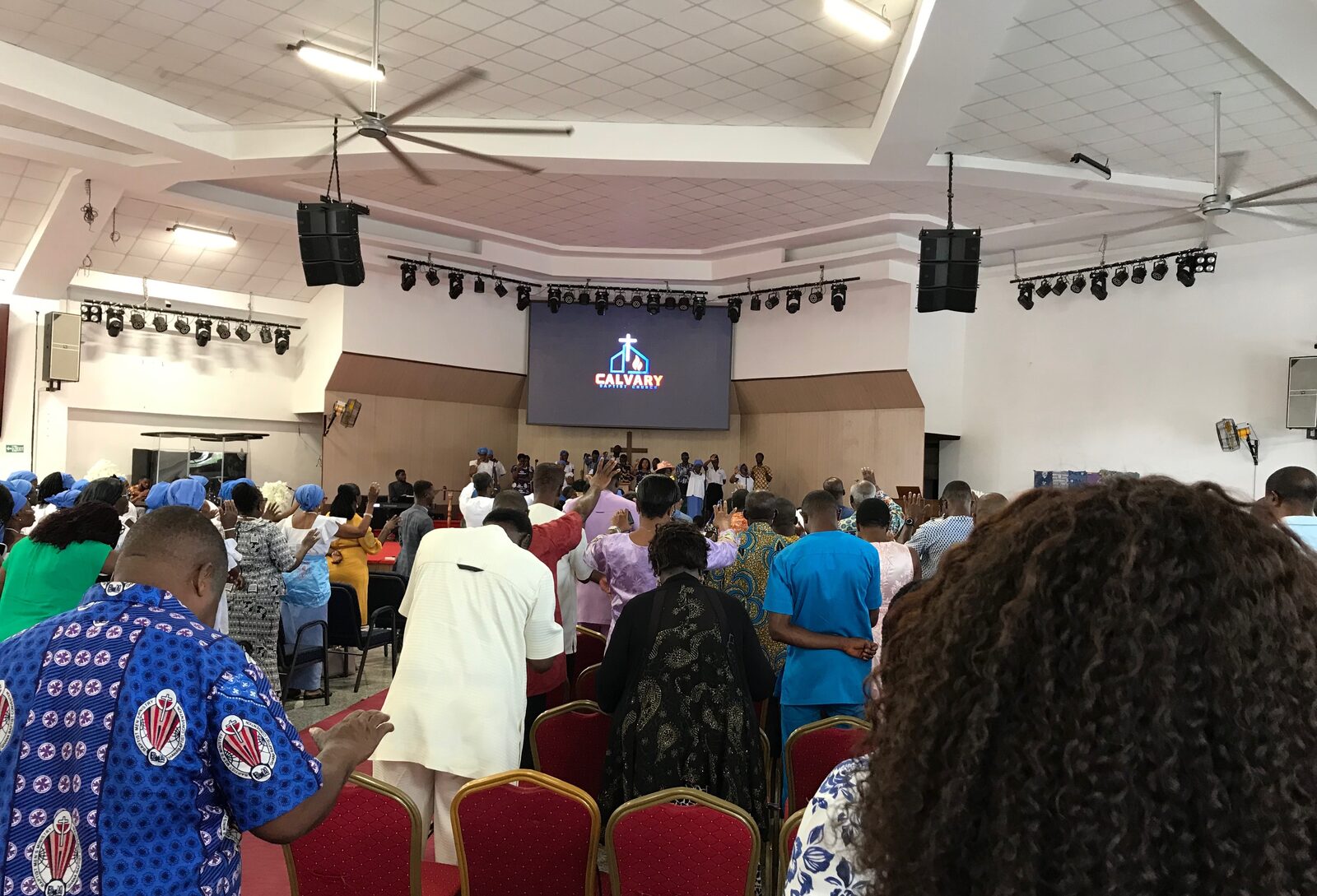
Worship service at Calvary Baptist Church in Shiashie, Ghana. Ghana appears throughout the retention and attendance data used in this entry.
What this entry asks
- How large is the regional shift, and what can the published data actually say about when sub-Saharan Africa overtook Europe?
- Does the current evidence point more to demography and retention, or to large-scale religious switching, as the main driver?
- Is this mainly nominal identification, or does the available practice data point to deeper religious engagement?
30.7%
+31.2%
81%
From the margins to the centre - in one century.
In 1900, sub-Saharan Africa held roughly 1% of the world's Christians. By 2020, it held 30.7%, the largest share of any region on earth.[1][6]
That is a shift from the margins to the centre of global Christianity in a single century. The data does not tell us the exact year the region overtook Europe, but it tells us it happened sometime in the 2010s, and that the direction across the full period is not in doubt.[1][6]
The story of how that happened, and what is sustaining it, is what the rest of this entry examines.
Sub-Saharan Africa holds more of the world's Christians than Europe.
In 2020, sub-Saharan Africa accounted for 30.7% of all Christians globally, the largest share of any region. Europe, which many still picture as the historical heartland of the faith, was down to 22.3%. The Middle East and North Africa, the geographic origin of Christianity, accounted for 0.6% of the global total.[1]
The chart shows the full regional picture.
Two regions are growing. Two are in decline.
Between 2010 and 2020, the Christian population of sub-Saharan Africa grew by 31.2%, the fastest of any region. Asia-Pacific grew by 6.1%, and Latin America and the Caribbean by 3.1%.[2]
Over the same decade, Europe's Christian population declined by 8.8% and North America's by 10.8%.[2]
It is not conversion driving this. It is who stays.
The primary driver of African Christian growth is retention: people raised Christian in sub-Saharan Africa overwhelmingly remain Christian as adults. In Nigeria, 98% of adults raised Christian still identify as Christian. Ghana: 97%. Kenya: 96%.[3]
Combined with the region's broader demographic growth, that retention produces the numbers the earlier charts show.[2][3] In a region where births are still rising, a large Christian population that keeps most of its adult identifiers will keep growing faster than regions where leaving is common.[3][7]
In the United Kingdom, only 58% of those raised Christian still identify as Christian. In the Netherlands, 53%. The trend reshaping Christianity in the West has no counterpart in sub-Saharan Africa, at least not yet.[3]
In the West, leaving is now common. In sub-Saharan Africa, it is rare.
The retention story has a mirror: defection. In the Netherlands, roughly 47% of those raised Christian now identify as having no religion. Spain: 40%. Germany and the United Kingdom: around 37-38%. Canada: 36%.[3]
In Nigeria, the defection rate to no religion is 1%. Ghana: 2%. Kenya: 1%. The gap between those two sets of numbers reflects a fundamental difference in how the two regions relate to religious identity over a lifetime.[3]
South Africa is the clearest exception on the African side: 8% defection, notably higher than the continental norm. Its 81% retention and 60% weekly attendance also sit below the broader sub-Saharan pattern, though still above many Western benchmarks.[3][5]
Retention is only part of the mechanism. The demographic backdrop matters too.
Retention explains who stays. The birth figures explain the underlying scale.
Africa's share of world births rose from 27.68% to 32.94% between 2010 and 2020. Europe's fell from 5.75% to 5.17%. The gap between those two trajectories is part of why the Christian population numbers move the way they do.[7]
This is continent-wide context, not a Christian-only measure. North Africa accounts for around 14% of Africa's births, so most of the weight still sits south of that line.[7]
Not just identification. Practice deepens the picture.
In Nigeria, 88% of Christians attend services at least weekly. Ghana: 83%. Kenya: 80%. Across all 16 countries in Pew's sub-Saharan Africa study, no country falls below 60%.[5]
These figures come from a 2010 Pew survey of 16 sub-Saharan African countries. They answer a different question: not who identifies as Christian, but who shows up.[5]
Weekly church attendance among Christians is lower in the United States and lower still in the United Kingdom. The region that holds the largest share of the world's Christians is also, by practice data, among the most actively observant.[4][5]
From the margins to the centre - in one century.
In 1900, sub-Saharan Africa held roughly 1% of the world's Christians. By 2020, it held 30.7%, the largest share of any region on earth.[1][6]
That is a shift from the margins to the centre of global Christianity in a single century. The data does not tell us the exact year the region overtook Europe, but it tells us it happened sometime in the 2010s, and that the direction across the full period is not in doubt.[1][6]
The story of how that happened, and what is sustaining it, is what the rest of this entry examines.
Sub-Saharan Africa holds more of the world's Christians than Europe.
In 2020, sub-Saharan Africa accounted for 30.7% of all Christians globally, the largest share of any region. Europe, which many still picture as the historical heartland of the faith, was down to 22.3%. The Middle East and North Africa, the geographic origin of Christianity, accounted for 0.6% of the global total.[1]
The chart shows the full regional picture.
Two regions are growing. Two are in decline.
Between 2010 and 2020, the Christian population of sub-Saharan Africa grew by 31.2%, the fastest of any region. Asia-Pacific grew by 6.1%, and Latin America and the Caribbean by 3.1%.[2]
Over the same decade, Europe's Christian population declined by 8.8% and North America's by 10.8%.[2]
It is not conversion driving this. It is who stays.
The primary driver of African Christian growth is retention: people raised Christian in sub-Saharan Africa overwhelmingly remain Christian as adults. In Nigeria, 98% of adults raised Christian still identify as Christian. Ghana: 97%. Kenya: 96%.[3]
Combined with the region's broader demographic growth, that retention produces the numbers the earlier charts show.[2][3] In a region where births are still rising, a large Christian population that keeps most of its adult identifiers will keep growing faster than regions where leaving is common.[3][7]
In the United Kingdom, only 58% of those raised Christian still identify as Christian. In the Netherlands, 53%. The trend reshaping Christianity in the West has no counterpart in sub-Saharan Africa, at least not yet.[3]
In the West, leaving is now common. In sub-Saharan Africa, it is rare.
The retention story has a mirror: defection. In the Netherlands, roughly 47% of those raised Christian now identify as having no religion. Spain: 40%. Germany and the United Kingdom: around 37-38%. Canada: 36%.[3]
In Nigeria, the defection rate to no religion is 1%. Ghana: 2%. Kenya: 1%. The gap between those two sets of numbers reflects a fundamental difference in how the two regions relate to religious identity over a lifetime.[3]
South Africa is the clearest exception on the African side: 8% defection, notably higher than the continental norm. Its 81% retention and 60% weekly attendance also sit below the broader sub-Saharan pattern, though still above many Western benchmarks.[3][5]
Retention is only part of the mechanism. The demographic backdrop matters too.
Retention explains who stays. The birth figures explain the underlying scale.
Africa's share of world births rose from 27.68% to 32.94% between 2010 and 2020. Europe's fell from 5.75% to 5.17%. The gap between those two trajectories is part of why the Christian population numbers move the way they do.[7]
This is continent-wide context, not a Christian-only measure. North Africa accounts for around 14% of Africa's births, so most of the weight still sits south of that line.[7]
Not just identification. Practice deepens the picture.
In Nigeria, 88% of Christians attend services at least weekly. Ghana: 83%. Kenya: 80%. Across all 16 countries in Pew's sub-Saharan Africa study, no country falls below 60%.[5]
These figures come from a 2010 Pew survey of 16 sub-Saharan African countries. They answer a different question: not who identifies as Christian, but who shows up.[5]
Weekly church attendance among Christians is lower in the United States and lower still in the United Kingdom. The region that holds the largest share of the world's Christians is also, by practice data, among the most actively observant.[4][5]
The data shows a completed shift. Sub-Saharan Africa is the demographic center of global Christianity.[1] The pattern points more to demographic weight, high retention, and low defection than to conversion.[3][7] The practice data points to active observance in many of the countries now anchoring that center.[5]
What this entry does not claim is that any of this causes or prevents particular social or development outcomes. That is a separate question requiring different data. Nor does it project these trends forward. South Africa’s exception is a reminder that patterns change. What it shows is where things stand.
Limitations
- The regional share, growth, retention, and defection figures come from Pew Research Center's June 2025 reporting, built from more than 2,700 sources including national censuses and demographic surveys.
- The weekly attendance figures come from Pew's sub-Saharan Africa study published in 2010. They answer a different question from the 2025 identity estimates and should be treated as complementary rather than merged into one metric.
- The demographic-context chart uses Africa-wide birth shares from an Our World in Data series based on UN World Population Prospects 2024. It is broader continental context, not a Christian-only measure, and it does not isolate sub-Saharan Africa from North Africa.
- The 1900 figure for sub-Saharan Africa's share of world Christians is historical framing, not a figure sourced with the same precision as the 2020 estimate.
- The Netherlands defection figure of about 47% is derived from the retention figure of 53%, so it should be read as approximate.
- Gordon-Conwell's 2025 growth rate of 2.59% per year covers Africa as a whole and does not isolate sub-Saharan Africa.
Sources
Primary
- Pew Research Center. How the Global Religious Landscape Changed From 2010 to 2020. June 9, 2025. https://www.pewresearch.org/religion/2025/06/09/how-the-global-religious-landscape-changed-from-2010-to-2020/
- Pew Research Center. Christian Population Change. June 9, 2025. https://www.pewresearch.org/religion/2025/06/09/christian-population-change/
- Pew Research Center. Around the World, Many People Are Leaving Their Childhood Religions. March 26, 2025. https://www.pewresearch.org/religion/2025/03/26/around-the-world-many-people-are-leaving-their-childhood-religions/
Context
- Pew Research Center. The World’s Most Committed Christians Live in Africa, Latin America and the U.S.. August 22, 2018. https://www.pewresearch.org/short-reads/2018/08/22/the-worlds-most-committed-christians-live-in-africa-latin-america-and-the-u-s/
- Pew Research Center. Islam and Christianity in Sub-Saharan Africa, Chapter 2: Tolerance and Tension. 2010. https://www.pewresearch.org/wp-content/uploads/sites/20/2024/06/sub-saharan-africa-chapter-2.pdf
- Pew Research Center. Global Christianity: A Report on the Size and Distribution of the World’s Christian Population. December 2011. https://www.pewresearch.org/religion/2011/12/19/global-christianity-exec/
- Our World in Data. Number of births per year (grapher dataset, historical values plus projections based on UN World Population Prospects 2024). https://ourworldindata.org/grapher/number-of-births-per-year.csv